Clearing an athlete to return to play is one of the highest-stakes decisions in orthopedic medicine. Get it right and you protect an athlete's career. Get it wrong and you risk a reinjury that may end it.
Most clearance decisions today are made with a combination of functional testing, subjective patient report, and clinical judgment.
None of these is wrong. All of them are incomplete without objective motion data.
The problem with ‘feels good enough’
Self-reported readiness is a poor predictor of reinjury risk. Study after study has shown that athletes feeling ready correlates weakly with biomechanical readiness.
This isn't an athlete failing. Confidence and competence rise on different curves, and the athlete has no way to see their own compensation patterns.
What functional tests miss
Standard functional tests — single-leg hop, Y-balance, isokinetic strength — measure capacity under controlled conditions.
They do not measure how an athlete moves under fatigue, across 18 hours of daily load, or during sport-specific transitions.
The gap between controlled-condition performance and real-world loading is where reinjuries happen.
Motion data catches what the rest miss
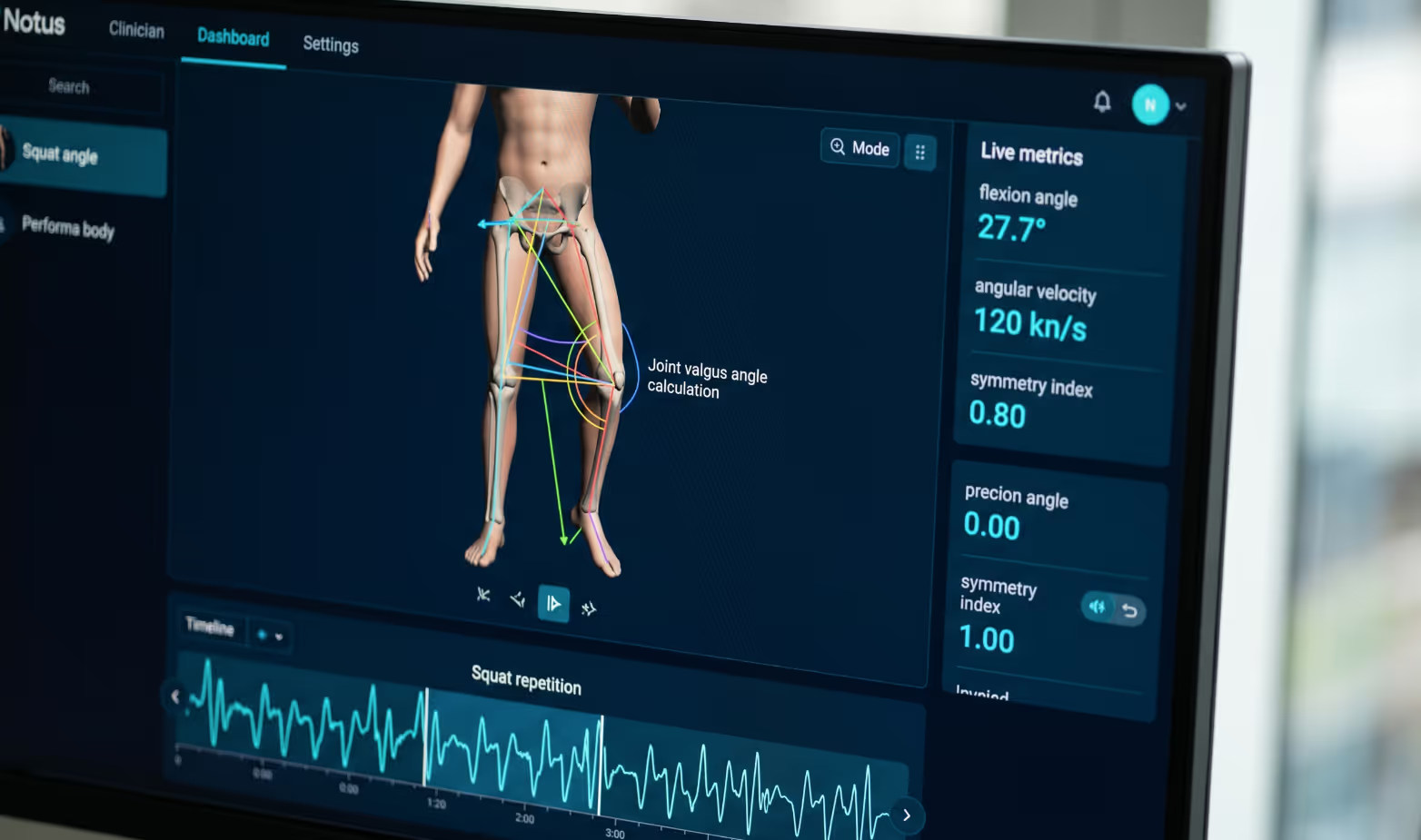
Continuous biomechanical monitoring sees the compensation patterns that functional tests can't replicate and the athlete can't feel.
Asymmetric loading over a day of practice. Valgus moments during cutting that only appear when fatigued. Quadriceps dominance that stabilizes under low load but breaks down under high load.
These are the patterns that precede reinjury. They're invisible to everyone — athlete, clinician, and functional test — until the continuous data surfaces them.
Clearance shouldn't be the moment an athlete passes a test. It should be the moment the data stops showing compensation.
The three signals worth integrating:
- Functional test performance under controlled conditions
- Athlete-reported readiness and confidence
- Continuous biomechanical data across real training load
- No single signal is sufficient on its own
- All three together approximate a complete picture
The clinicians we work with aren't using motion data to replace their clinical judgment. They're using it to see what clinical judgment alone can't reach.
Objective data doesn't decide for you. It makes sure the decision is made with everything that matters on the table.