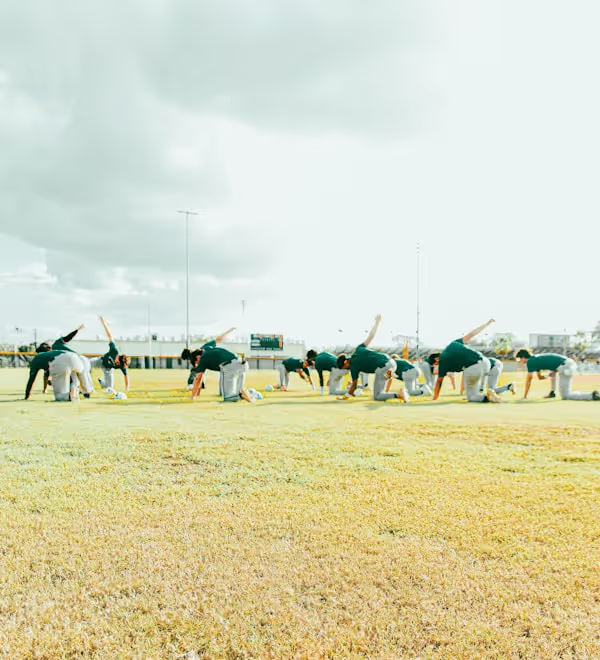
Most injuries don't happen out of nowhere. They happen in the compensations, asymmetries, and loading habits that an athlete builds over weeks — patterns that are visible in motion data long before they show up on clinical exam or in the athlete's own experience.
Pre-season biomechanical screening is our research program for catching those patterns early, across healthy collegiate and high school athletes in active competition.
What we're learning is changing what pre-season screening actually means.
The research question
Functional pre-season screening has been standard practice for decades — FMS batteries, Y-balance tests, single-leg hop symmetry. All useful. All sample capacity under controlled conditions, in one moment, against a known task.
The question we wanted to answer: what do athletes look like when they're not being tested? And do those everyday patterns predict injury better than the sideline assessments we've been relying on?
The cohort
Multi-sport enrollment across ACL-healthy athletes in collegiate and high school programs. Football, soccer, basketball, lacrosse, volleyball.
Each athlete wore the Notus Labs armband continuously through pre-season and the first eight weeks of competition. Daily loading, landing symmetry, knee-in moment during cutting — all measured in real context, not in the athletic training room.
No intervention. Just observation.
What the data showed
Athletes who later experienced non-contact lower-extremity injuries showed measurable loading asymmetries in motion data an average of 58% earlier than their clinical pre-season screening flagged them as at-risk.
Functional test symmetry did not reliably predict continuous-loading symmetry. Athletes who passed FMS and Y-balance often showed persistent 6 to 10% limb asymmetry during normal practice loading — a signal that wouldn't appear in any standard sideline assessment.
The compensation patterns that preceded injury weren't new. They'd been building in the data for weeks.
Injury prevention used to mean responding faster. Now it can mean seeing the pattern six weeks before anyone feels it.
What pre-season screening has shown so far:
- Compensation patterns surface in continuous data up to six weeks before symptoms
- Baseline asymmetry quantified in real training context, not on a testing day
- Fatigue-induced compensation visible across full practices, not sampled
- Inter-athlete benchmarks grounded in continuous load exposure
- Intervention targets identified before injury, not after
Pre-season screening isn't being replaced by continuous monitoring — it's being completed by it. Functional tests answer capacity questions. Continuous data answers exposure questions. Both matter.
The research continues across multiple collegiate and high school programs. Athletes identified as at-risk through continuous screening are enrolling in targeted intervention protocols, and the preliminary data on outcome modification is strong.