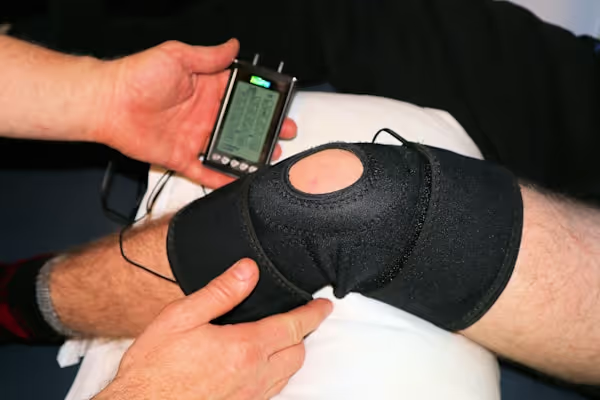
In late 2023, Notus Labs partnered with the orthopedic surgery department at Case Western Reserve University to run what we believe is the first longitudinal biomechanical monitoring study on post-ACL recovery.
The design was simple. The findings changed how we thought about the clinical window.
Two and a half years later, the study has grown into an ongoing research collaboration. This is what we learned from the first cohort.
Study design: 60 patients, 24 weeks
Sixty patients, all post-ACL reconstruction, enrolled between surgery and week two of rehab. Continuous biomechanical sensing for 24 weeks via the Notus Labs armband.
Standard clinical milestones at weeks 8, 12, 16, 20, and 24. No change to the rehab protocol — the study was observational. We wanted to see what continuous data would reveal that standard exam couldn't.
What the data showed at week 8
Week 8 is traditionally the checkpoint for early functional movement. Clinically, patients looked on-schedule.
In the motion data, nearly 40 percent showed persistent inter-limb asymmetry during basic squat and step-down tasks. These weren't subjective reports of discomfort. They were quantified load asymmetries of 12 to 18 percent, well outside any reasonable return-to-sport tolerance.
That finding was the first surprise of the study.
What we saw at weeks 16 through 24
By week 16, most patients were meeting traditional functional tests — hop tests, isokinetic strength, balance batteries. But the motion data told a more nuanced story.
Compensation patterns that had looked like they were resolving at week 12 often re-emerged when training load increased. Patients who passed strength testing at week 20 frequently still showed valgus collapse under sport-specific loading at week 24.
The clinical tests weren't wrong. They were just incomplete.
Standard exam captured 20 minutes of controlled movement every two weeks. The sensor captured 18 hours a day. Those are different datasets.
What the first cohort changed:
- Added continuous monitoring as a clearance prerequisite, not a supplementary signal
- Extended the expected biomechanical recovery window to 12 to 18 months
- Built valgus collapse under fatigue into our standard clearance panel
- Shifted compensation intervention to week 8 rather than week 16
- Started publishing de-identified cohort data to the research community
We published initial findings with Case Western in 2024. The protocol changes we made based on the study are now part of every deployment on our platform.
The study continues. The second cohort is now at month 18 of follow-up, and the questions we're asking have gotten sharper than we expected when we started.